
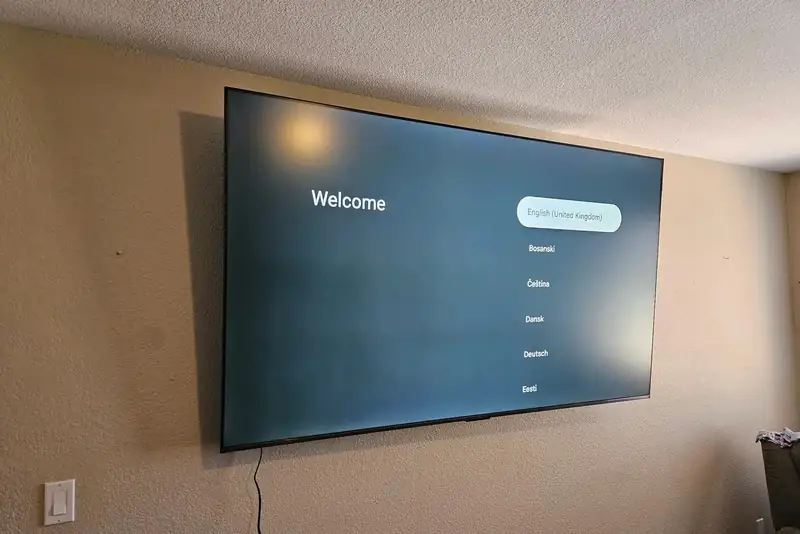
Your wall can almost certainly hold a big new TV, but only if three things line up: a mount rated for the new TV's weight and hole pattern, fasteners that bite into solid framing instead of just drywall, and a plan for the power cord that follows electrical code. In a lot of Las Vegas homes the old mount from the last TV fails the first test, and the wall itself decides the rest. Here is what to check before the new screen from the Black Friday sales goes up.
Check the TV weight and VESA pattern before buying a mount
Every wall mount lists two limits: the heaviest TV it carries and the hole patterns it fits. Both numbers are printed in the new TV's manual or spec sheet, usually listed as the weight without the stand and the VESA mounting pattern. If either number is outside what the old mount allows, the old mount stays in the garage, even if it looks sturdy.
The hole pattern comes from the VESA Flat Display Mounting Interface standard. Large TVs use the MIS-F version, where the screw holes form a square with holes every 100 mm along the edges and standard M6 or M8 machine screws. A TV that moved up a size or two often moved to a wider pattern too, such as 400 x 400 instead of a smaller square, so measure the distance between the screw centers on the back of the new TV and compare it to the mount's listed patterns.
Quick check: if the new TV is heavier or has a wider hole pattern than the old mount's label allows, buy a new mount rated for it. A mount that is close to its limit is the weak point, no matter how solid the wall is.
What is behind Las Vegas drywall: wood studs, metal studs and block
A mount is only as strong as what its lag bolts or anchors go into, and Las Vegas homes hide three different things behind the paint.
- Wood studs. Most interior walls in Las Vegas and Henderson houses are wood framed. A mount bolted into the center of two wood studs is the simplest and strongest setup, and most mounts ship with lag bolts made for exactly that.
- Metal studs. Steel framing shows up in some condos, townhomes, newer remodels and commercial spaces. Wood lag bolts do not hold in steel, so a steel stud install needs a hardware kit made for it. One major mount maker says it does not recommend a full motion mount in steel studs at all, which matters if you wanted an arm that swings the TV out.
- Block and masonry. Fireplace surrounds, some exterior walls and accent walls can have concrete block, brick or tile backer behind the finish. These walls hold a lot of weight, but they need masonry anchors and the right drill, and a stud finder made for drywall reads them poorly.
Knocking on the wall and trusting a cheap stud finder is how mounts end up in the middle of a hollow bay held by drywall alone. Find the framing first, then pick the hardware.
Fixed, tilting or full motion mounts
The right TV mount depends on where you sit and how high the TV has to go.
- Fixed mounts hold the TV flat and close to the wall. They are the simplest, the strongest for the weight and the cleanest look, and they suit a TV at seated eye level across from the couch.
- Tilting mounts angle the screen down a few degrees. They help when the TV sits higher than eye level, such as over a console or a fireplace, and they cut glare from windows and ceiling lights.
- Full motion mounts use an arm to pull the TV out and turn it toward another seat or the kitchen. The arm puts much more leverage on the wall, so they need solid framing, a mount rated well above the TV's weight and, on steel studs, usually a different plan entirely.
A bigger screen also means a bigger lever. The same full motion arm that was fine for the old TV can sag or pull on the wall with a heavier one.
Mounting above a fireplace
Putting a TV above a fireplace is common in Las Vegas living rooms, and it raises two questions: heat and height. On heat, a gas fireplace manufacturer notes that most TVs are rated for operating temperatures up to about 100 to 104°F, that a mantel only deflects rising heat slightly, and that the fireplace's own installation manual sets the clearances for anything mounted above it. Read both manuals, the fireplace's and the TV's, before drilling.
On height, the same guidance puts the center of the screen at roughly seated eye level. A TV above a mantel is usually well above that, so a tilting mount or a pull down mount that lowers the TV for viewing makes the room more comfortable. Fireplace walls are also the ones most likely to hide block, tile backer or extra framing, so plan the anchors for that wall type, not for plain drywall.
Hiding the cords without breaking code
The cleanest look is a TV with no cords showing, but the TV's power cord cannot simply be pushed into the wall cavity. The National Electrical Code, as explained in EC&M's code Q&A on Section 400.12, does not allow flexible cords and power supply cords to run through holes in walls or be concealed by walls. A TV power cord or a power strip cord stuffed behind the drywall is exactly that.
There are two code friendly ways to hide the wires in a Las Vegas home:
- A recessed outlet behind the TV. A new receptacle is installed in the wall behind the screen and fed with proper in-wall wiring, so the TV plugs in right where it hangs.
- A listed in-wall power kit. These kits use in-wall rated cable between two recessed plates, with the TV cord plugging in behind the screen and a short cord at the bottom plate. Follow the kit's instructions exactly, since the listing depends on it.
Low voltage cables such as HDMI and speaker wire can run through the wall when they are rated for in-wall use. If you would rather not open the drywall at all, a paintable surface raceway hides the cords in a channel on the wall instead.
Do not skip the tip-over risk for the old TV
If the old TV is moving to a bedroom or game room on a dresser, anchor it. The U.S. Consumer Product Safety Commission's holiday guidance says it is critical to anchor a new TV or furniture to the wall, and to keep TVs on a sturdy, low base pushed back as far as possible when anchoring is not possible. A wall mount or an anti tip strap does that job.
When to hand the job to an installer
A small TV on a fixed mount into wood studs is a reasonable weekend project. A big new screen is a different job when any of these are true:
- The wall has metal studs, block, brick or a fireplace surround.
- You want a full motion arm or a pull down mount over a mantel.
- You want the cords hidden and need a recessed outlet or in-wall power kit installed.
- The TV is too large and heavy for two people to lift onto a mount safely.
- You want the TV up and working before holiday guests arrive.
Fix & Finish handles TV mounting and AV installation in Las Vegas, including finding the framing, choosing a mount rated for the new TV, mounting over fireplaces and hiding the wires the code friendly way. If the TV is part of a larger setup with surround sound or a projector, the home theater installation guide covers what changes. If the new TV needs better lighting around it, see lighting installation.
Bought the TV already? Contact Fix & Finish with the TV model and a photo of the wall, and the team can tell you what the mount and the wall need before the holidays.